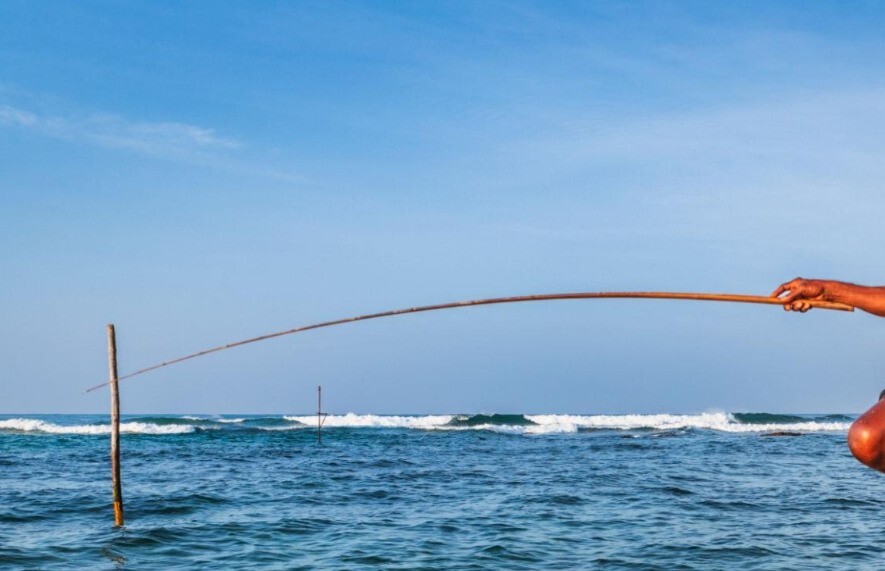
The traditional art of crafting the Kitul Piththa rod has been preserved for centuries by coastal fishing communities. Each rod carries generations of wisdom, strength, and deep respect for nature.
The process begins with choosing the correct Kitul tree (කිතුල් ගස). Traditional fishermen distinguish between female and male trees based on structure and leaf arrangement. The female Kitul tree is considered the most suitable for rods — its leaves grow closely together, indicating stronger piththa. The male tree produces Val Piththa (වැල් පිත්ත) and is less preferred.
This ability to identify the best tree is part of a valuable traditional knowledge system, passed down through generations and known only to experienced fishermen.
🌿 ගස තෝරාගැනීමOnce a suitable tree is found, fishermen carefully cut only a few piththa sections, ensuring the tree is not unnecessarily damaged. The leaves are trimmed away, and the selected piththa is taken home for preparation. In earlier times, Kitul trees were abundant, but today they are becoming increasingly rare, making this material even more precious and respected.
🪓 පිත්ත කපා ගැනීමAfter harvesting, the piththa is placed on the roof of the house and left to dry naturally in the sun. This drying stage is essential, as it strengthens the material and prepares it for shaping before the fishing season begins. Proper drying ensures the rod remains durable and resistant to damage, ready to face the ocean waves.
🌞 අව්වේ වියළීමIf the piththa is bent or uneven, fishermen apply coconut oil and warm it over a large fire. Once heated, the rod becomes flexible enough to be straightened by hand. Because of the heat, fishermen protect their hands with cloth while carefully shaping it into the correct form. This process requires patience and precision, ensuring the finished rod is perfectly balanced and strong.
🎋 හැඩගැන්වීමAfter shaping, the rod is cleaned and fitted with a Thanguwa (තංගුව), a traditional connector that links the handcrafted Bilikatuwa (බිලිකටුව) hook to the piththa. The knot used in this step is highly specialized — tied in a unique way known only to skilled fishermen. According to tradition, only the person who tied it can untie it, reflecting deep craftsmanship.
🔗 උපකරණ සවි කිරීමThe completed Kitul Piththa rod is not a single-use tool. It is designed for long-term use and can support fishing activities over many seasons. After each trip, it is carefully stored in a safe place to preserve its condition. During off-seasons, fishermen may also use the same rod in lakes and the sea with different hooks — a true testament to its durability.
🏝️ කල් පවතින රිටි පිත්ත
✨ A Living Tradition ✨
The making of the Kitul Piththa is more than a practical process — it
is a cultural tradition that represents knowledge, sustainability, and
identity. Every rod carries the wisdom of generations, keeping Sri
Lanka’s stilt fishing heritage alive for the future. From selecting
the sacred Kitul tree to the final knot, each step honors the
ancestors and the ocean.
Image placeholder — add photo of Kitul tree
Placeholder — natural drying on rooftop
Placeholder — heating & straightening
Placeholder — Thanguwa & Bilikatuwa assembly
† These image slots are ready for your future photographs — replace with actual process images anytime.