Stilt fishermen catch fish without bait. The secret is the Bilikatuwa, a hook cast by hand from lead in a mould carved from cuttlebone and shaped like a small fish.
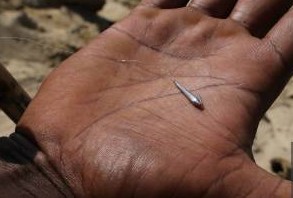
A handmade Bilikatuwa hook.
Materials: cuttlebone (දැලිපොතු / dalipothu), white and black lead (ඊයම් / eeyam), stainless steel wire (කම්බි), and thread to tie the mould shut.
Tools: a three-square file (පීර / peera), a small knife (පිහිය), a small hammer (මිටිය), a spoon (හැන්ද), a gas lamp for heating, and a piece of broken bulb glass for polishing.
The finished Bilikatuwa is strong, sharp and shaped and polished like a small shining fish. Moving in the waves, it attracts the fish by itself, so the fisherman needs no bait. It is fitted to the Kitul Piththa rod with the Thanguwa connector.
The knowledge of making the Bilikatuwa was the most closely guarded secret of stilt fishing. Only two or three fishing families knew how to make it, and they passed it only from father to son, never to other families. It is one of the quiet skills that keep Sri Lanka’s stilt fishing heritage alive.
Visit our fishing family in Koggala. We show you the Rita, the Piththa and the Bilikatuwa up close, explain how each is made, and, when the sea allows, let you sit on a stilt yourself.
Book on WhatsApp See experiences and pricesNo. They use the Bilikatuwa, a shiny handmade lead hook shaped like a small fish, which attracts fish without any bait.
Lead cast around a short stainless steel wire, in a mould carved from cuttlebone, then filed, sharpened and polished.
Up to eight, because the mould is carved like a fish skeleton with a branch for each hook.
Ask us when you book your visit in Koggala and we will show you the hooks and how they are made.
New to stilt fishing? Start with our visitor guide and is stilt fishing real or fake?
